Résumé de section
-
- § Mohamed Lamine Debaghine University, Setif 2.
- § Faculty of Letters and Languages.
- § Department of English Language and Literature.

- § Course ∕ Module: Study Skills 1 (TTU 1)
- § Course teaching unit: Methodology
- § Target Level: 1st Year LMD
- § Coefficient: 2
- § Credits: 4
- § Allotted Time: 2 semesters
- § Time per week: 1h 30 min
- § Evaluation mode: written + continuous
- § Instructor: Dr. FADEL Houda
- § E-mail: h.fadel@univ-setif2.dz
-
By the end of the course, students will be able to:
- Set academic goals, apply effective learning strategies, and demonstrate achievement in their courses.
- Demonstrate independent learning skills and apply critical thinking in academic and real-life contexts.
- Develop and apply reading, writing, and research methodology skills effectively.

-
Students should be aware of basic techniques of English use.

-
-

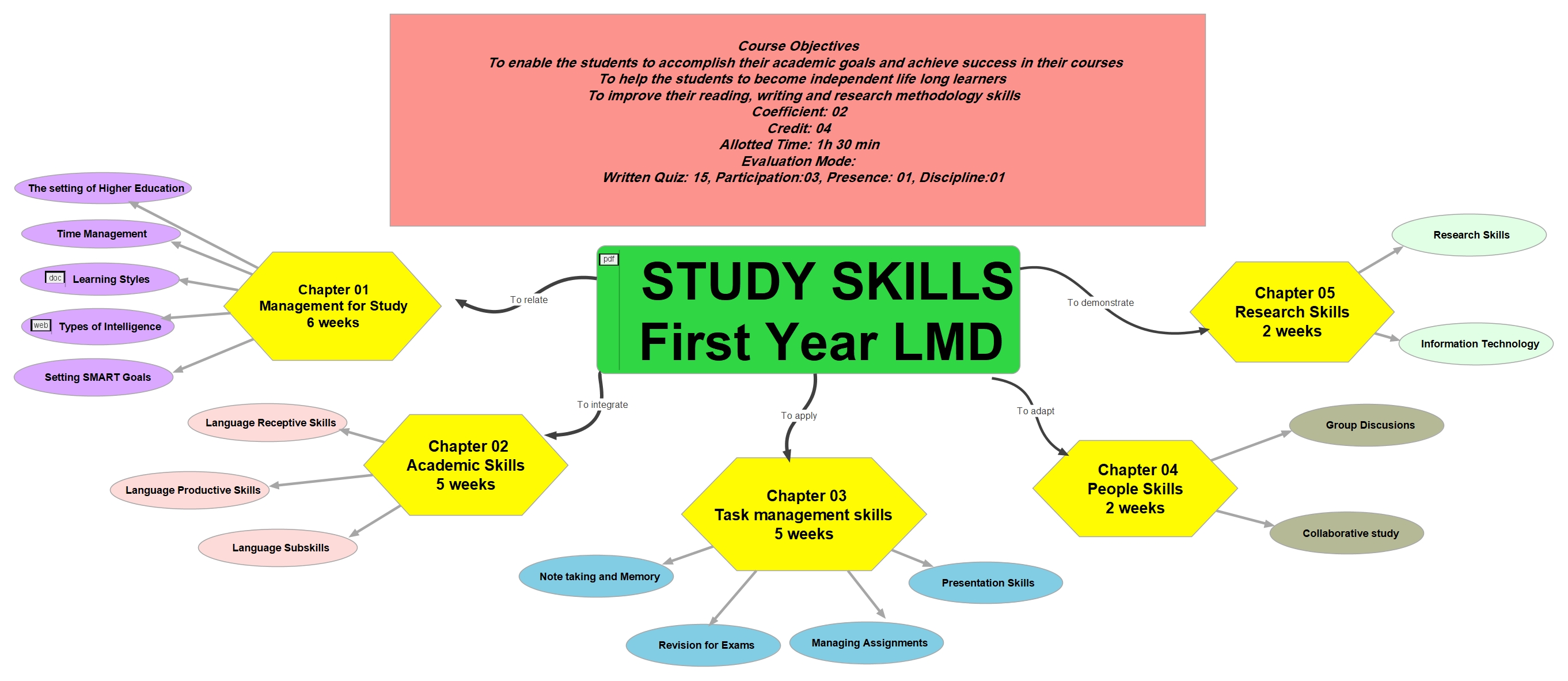
The course deals with different points which are related to one another. Each point is clarified with series of tasks and activities to reinforce and simplify understanding. The content is divided into five chapters, each chapter with a set of lessons as follows:
Chapter 1: Management for study
1. The setting of Higher Education
2. Time Management
3. Learning styles
4. Types of intelligence
5. Setting SMART goals
Chapter 2: Academic Skills
1. Language Receptive Skills
2. Language Productive Skills
3. Language Subskills
Chapter 3: Task Management Skills
1. Note-taking and Memory
2. Revision for exams
3. Managing Assignments
4. Presentation Skills
Chapter 4: People Skills
1. Collaborative Study
2. Group Discussions
Chapter 5: Research Skills
1. Research Skills
2. Information-technology and web-based learning
-

Chapter 1: Management for study. Students will be able to:
· Understand the structure of higher education.
· Apply effective time management strategies.
· Recognize personal learning styles and types of intelligence.
Set SMART academic and personal goals
-
Chapter 2: Language Skills. Students will be able to:
· Identify and develop receptive (listening and reading) and productive (speaking and writing) language skills.
· Use language subskills effectively in academic tasks
-

Chapter 3: Task Management Skills. Students will be able to:
· Demonstrate effective note-taking and memory strategies.
· Plan and implement revision schedules and assignment timelines.
· Prepare and deliver clear academic presentations.
-

Chapter 4: People Skills. Students will be able to:
· Engage in collaborative study activities.
· Participate effectively in group discussions by communicating ideas clearly and respecting diverse opinions
-

Chapter 5: Research Skills. Students will be able to:
· Apply basic research skills to academic tasks.
· Use information technology and web-based resources to gather, evaluate, and integrate information effectively.
-

Students’ progress is evaluated using a combination of written and continuous assessment:
a. Continuous Assessment: (25%) (5 points)
Students are evaluated based on three elements:
· Participation
· Presence
· Discipline
b. Written Assessment: (75%) (15 points)
Students sit for a written exam by the end of each semester, in which they answer a set of various activities testing their knowledge and understanding of the introduced content.
The final mark is the sum of the continuous and the written assessments to have a mark out of 20.
-
-

- · Bain, K. (2012). What the best college students do. Cambridge, MA: Harvard
- · Briggs. C.I and Dummett. P.C. (1996). Skills Plus- Listening and Speaking- Advanced. Macmillan Heinemann.
- · Cottrell, S. (2003). The study skills handbook. Basingstoke: Palgrave Macmillan
- · Dawson, C. (2011). The complete study skills guide: A practical guide for all students who want to know how to learn.Oxford, UK: How To Books.
- · Devito.J.A. (2009). The Essential Elements of Public Speaking- 3rd Edition. Pearson.
- · Jaffe. C.I. (2016). Public Speaking Concepts and Skills for a Divers Society. Cengage Learning: USA.
- · Forsyth, P., & Connelly, J. (2010). The study skills guide: Essential strategies for smart students.London, UK: Kogan Page.
- · Rolls, N., &Wignell, P. (2009). Communicating at university: Skills for success (3rd ed.). Darwin, NT: Charles Darwin UniversityPress
- · Walmsley, B. (2010). Improve your study skills. London, UK: Teach Yourself
-

The fellow teachers and (the first year LMD student Ms. Kamel Nouha) from Mohamed Lamine Debaghine University, Setif 2, Faculty of Letters and Languages, Department of English Language and Literature, are gently asked to evaluate this course using the provided evaluation grid.
- Dr. Gherzouli Ikhlas. i.gherzouli@univ-setif2.dz
- Dr. Salem Sihem. s.salem@univ-setif2.dz
- Ms. Kamel Nouha. nouhakamel115@gmail.com